

The Hidden Enemy of Exterior Walls: How Modern Renders Prevent Algae and Green Staining
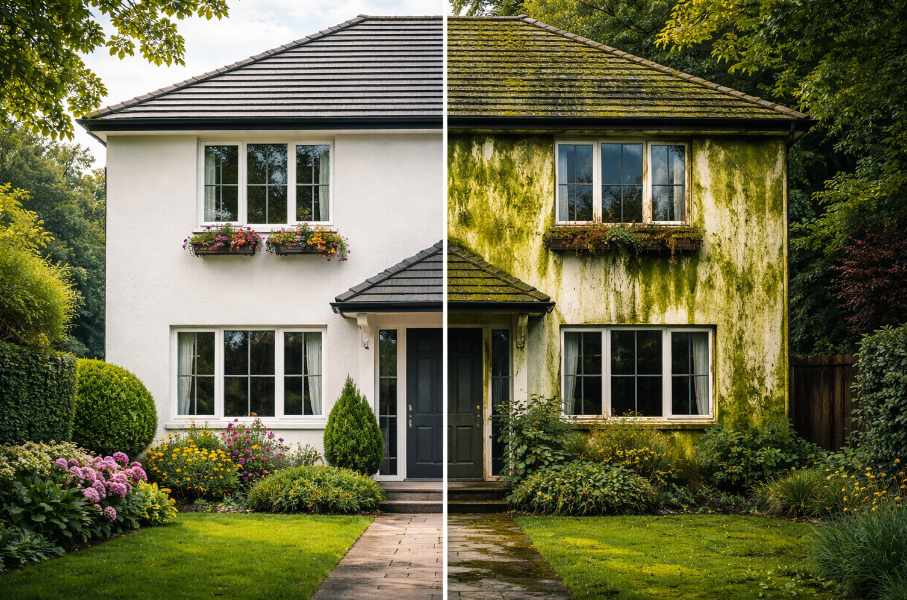 Walls rarely complain out loud, yet many quietly host a slow-growing invasion. One morning a homeowner looks outside and notices that the once-clean façade now has a faint green haze creeping across it. Give that haze a few seasons and the building can start looking like it belongs in a damp woodland rather than a suburban street.
The culprit is algae. It doesn't arrive with drama or fanfare. It simply settles, finds moisture, and begins multiplying with the patience of a creature that has absolutely nowhere else to be.
Exterior walls, especially those that face north or sit beneath shade, provide ideal conditions. Less sunlight means less heat and slower drying. Moisture lingers on the surface after rain, condensation, or morning dew. To algae, that's practically an invitation.
For homeowners, the result can be frustrating. Walls that were freshly finished not long ago suddenly look older than they should. Scrubbing, pressure washing, and repainting become recurring chores. Fortunately, modern render systems have quietly evolved to make life much harder for these microscopic squatters.
Why Shade Turns Walls Green
Sunlight does more than brighten a façade. It acts as a natural drying system. Walls that receive direct sunlight warm up during the day, allowing moisture to evaporate quickly.North-facing walls rarely enjoy that luxury. They remain cooler and damper for longer periods. Add nearby trees, tall fences, or neighboring buildings that cast shadows, and the wall becomes a moisture retention zone.
Algae thrive in these environments because they depend on water to grow. When surfaces stay damp for extended periods, microscopic spores can settle and develop into visible patches. At first the color is subtle. Then it deepens until the wall takes on a green tint that suggests the building might start photosynthesizing.
This process is rarely immediate. Growth builds gradually, which is why many homeowners overlook the early stages. By the time it becomes noticeable, the algae colony has already established itself comfortably.
Moisture Retention and the Surface Problem
Not all wall finishes behave the same way when exposed to moisture. Traditional cement renders often contain tiny pores that trap water. After rainfall, these pores can hold moisture near the surface for hours or even days.That lingering dampness creates an environment where algae can flourish.
Modern render systems approach the problem differently. They are engineered with surface properties that reduce water absorption while still allowing the wall to breathe. Instead of soaking up moisture like a sponge, these coatings encourage water to run off or evaporate quickly.
The difference may seem minor at first glance, yet it dramatically changes the biological conditions on the wall.
Think of it as the difference between a damp towel and a quick-dry athletic shirt. One stays soggy for ages. The other dries before algae even has time to unpack its suitcase.
Micro-Texture and the Battle Against Buildup
Surface texture also plays an important role in algae growth.Rough finishes with deep micro-pits create small shelters where moisture and organic debris can accumulate. These tiny pockets provide perfect footholds for algae spores.
Modern façade coatings are designed with controlled micro-textures that discourage this buildup. The surfaces remain slightly textured for visual appeal, yet smooth enough to limit water retention and dirt accumulation.
The effect is subtle but effective. Water beads and slides away rather than settling into microscopic craters.
Engineers often describe this as a self-cleaning tendency. When rainwater flows across the surface, it carries away dust and organic particles that algae would otherwise use as nutrients.
It's not magic. It simply makes the wall a far less comfortable place to live.
Surface Chemistry That Discourages Growth
Texture and moisture control handle part of the algae problem, but surface chemistry adds another layer of defense. Modern façade coatings are often formulated with additives that make the environment hostile to biological growth.Some coatings include mineral compositions that reduce nutrient availability on the wall's surface. Others incorporate protective agents that slow the development of algae colonies. These elements work quietly, interfering with the conditions that algae require in order to expand.
A traditional wall finish can act like an open buffet for microorganisms. Organic particles settle, moisture lingers, and the surface chemistry does little to resist biological activity.
Modern renders change that equation.
Water tends to bead and run off. Dirt struggles to cling to the coating. Nutrients wash away before algae can build a thriving community. In effect, the wall becomes a place where algae tries to settle down but quickly realizes the neighborhood lacks basic amenities.
This chemical strategy does not eliminate every spore that lands on the wall. Nature is persistent. However, it slows the process enough that visible staining becomes far less common.
Practical Benefits for Homeowners
For homeowners, the advantages of modern render technology are both visual and practical.Cleaner façades maintain their appearance longer, reducing the need for constant maintenance. Instead of annual pressure washing sessions that resemble a small construction project, walls remain bright and consistent for extended periods.
Modern coatings also help protect the structural materials beneath the render. By minimizing moisture absorption, they reduce the likelihood of long-term deterioration caused by repeated wetting and drying cycles.
Homeowners choosing modern façade systems often notice several improvements:
- Walls remain cleaner for longer periods.
- Algae staining appears far less frequently.
- Maintenance intervals become significantly longer.
- The building's exterior maintains its original color and finish.
And importantly, the homeowner spends fewer weekends arguing with a pressure washer that insists on spraying everything except the intended wall.
When Walls Refuse to Go Green
Exterior walls will always face environmental challenges. Rain, shade, airborne particles, and microscopic organisms are constant companions in the outdoor world.Modern render technology does not attempt to fight nature with brute force. Instead, it quietly shifts the balance. By controlling moisture behavior, refining surface texture, and adjusting chemical composition, these coatings create conditions where algae struggle to gain a foothold.
The wall dries faster. Dirt slides away. Nutrients disappear before microorganisms can take advantage of them.
Over time, this subtle combination makes a visible difference. Buildings retain their crisp appearance, shaded areas stay cleaner, and homeowners gain relief from the endless cycle of scrubbing and repainting.
In short, modern renders encourage algae to look elsewhere for real estate. The microscopic tenants eventually move on, leaving the walls behind looking far more respectable than the neighborhood moss had planned.
Article kindly provided by siliconerender.com
Latest Articles
- Can a House Be Too Well Insulated? Understanding the Other Half of Low-Energy Design
- Your Roof Needs to Breathe Too: The Link Between Ventilation, Condensation and Hidden Timber Damage
- Why Your Boiler Behaves Perfectly Until the Weather Turns Cold
- Why Roof Age Is Only Part of the Picture
- How HOA Boards Can Catch Pavement Problems Before They Get Expensive
- Why Vacuuming Alone Eventually Stops Making a Carpet Look Clean
- Designing a Garden That Still Works After the Sun Goes Down
- Why Your Boiler Sounds Different in Summer Than It Does in Winter
- Case Study: Patio Installation Costs in Newcastle
- Why Your Garden Could Be the Most Underrated Fitness Space You Own
- The Hidden Costs of Ignoring Tree Stumps After Felling
- How Much Does a New Roof Cost in Portsmouth? 2026 Pricing Guide
- Choosing the Right Hot Water System for the Way You Actually Live
- Why Beautiful Homes Sometimes Feel Uncomfortable to Live In
- Why Some Homes Always Feel Brighter Without Adding More Windows
- Why Some Roof Leaks Only Appear During Wind-Driven Rain
- Why the Most Memorable Rooms Usually Have One Thing That Feels Unexpected
- Case Study - How Much Does a New Roof Cost in Harrogate?
- Case Study - How Much Does Block Paving Cost in Derby?
- Solar Power: What Happens to Your Energy After Sunset?
- Interior Design
- Home Improvement
- Gardening
- Home Organization
- Home Maintenance
- DIY Crafts
- Kitchen and Dining
- Bathroom Design
- Home Security
- Home Automation
- Green Living
- Home Office
- Home Decor
- Garden Design
- Pet Care
- Home Technology
- Landscaping
- Home Energy Efficiency
- Home Cleaning
- Home Safety
- Home Exterior
- Home Insulation
- Home Buying
- Home Selling
- Renting
- Tradespeople
- Garage
- Bedroom
- Painting and Decorating
- Plumbing and Drainage