

Why Most Homes Are Over Lit - and How to Fix It Without Spending More
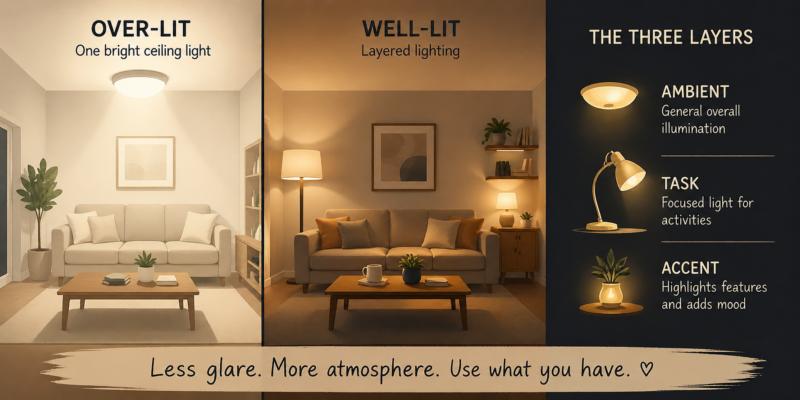 Light is often treated like a volume knob that only goes in one direction—up. Walk into many homes and you'll find a single ceiling fixture blazing away as if it's trying to interrogate the furniture. Everything is visible, yes, but not necessarily comfortable. The result is a room that feels flat, harsh, and oddly uninviting, even when the décor itself is perfectly fine.
This isn't a problem of taste so much as habit. Overhead lighting is convenient. It's the first switch by the door, the default choice, the "good enough" solution. But relying on one powerful source to do all the work is like expecting one person at a party to handle the music, the drinks, and the conversation. Something's going to feel off.
Why Bright Doesn't Mean Better
There's a common assumption that more light equals a better space. In reality, too much uniform brightness removes contrast, and contrast is what gives a room depth. Without it, everything blends together in a way that feels strangely lifeless. Shadows disappear, textures flatten, and even carefully chosen colors lose their impact.A brightly lit room can also be tiring. The eyes have no place to rest because every surface is equally exposed. It's the visual equivalent of someone talking at full volume without pause. Technically clear, but exhausting over time.
Understanding Layers Without Overthinking It
Professional designers often talk about three types of lighting: ambient, task, and accent. That might sound technical, but the idea is simple. Each type plays a different role, and when combined, they create balance instead of overwhelm.- Ambient lighting provides general illumination. This is your ceiling light or main source.
- Task lighting focuses on specific activities like reading, cooking, or working.
- Accent lighting highlights features, adds mood, and creates visual interest.
Using What You Already Have
Fixing an over lit room doesn't require a shopping spree. It starts with redistributing the light you already own. Instead of flipping on every overhead fixture, try turning it off entirely and relying on smaller sources.A floor lamp in the corner can soften the edges of a room. A desk lamp can create a focused, calming pool of light. Even a bedside lamp can double as ambient lighting if placed thoughtfully. The goal isn't to reduce light, but to spread it out in a way that feels intentional.
Position matters more than people expect. Light at eye level or below tends to feel warmer and more natural than light blasting down from above. It mimics how light behaves at sunset rather than at noon, and most spaces benefit from that shift.
Some rooms may already have more potential than they appear. That lamp you rarely use in the corner? It's not decorative backup—it's part of a better lighting plan waiting to happen.
Let Shadows Do Some Work
Shadows often get treated like a flaw, something to eliminate as quickly as possible. In reality, they're essential. Without shadows, a room loses dimension and becomes visually dull. A bit of darkness here and there creates contrast, and contrast makes everything else look better.This doesn't mean turning your home into a cave. It means allowing certain areas to be softer, less defined. Corners don't need to be fully illuminated. Walls don't need to glow from top to bottom. Letting light fade naturally across a space creates a sense of calm that no overhead fixture can replicate.
There's also a practical benefit. When light is uneven in a controlled way, it guides attention. Your eyes are drawn to the brighter, more intentional spots rather than wandering aimlessly. It's subtle, but it changes how a room is experienced.
Matching Light to Real Life
Rooms are often lit based on what they're called rather than how they're used. A "living room" gets a bright central light because that's what seems appropriate, even if most of the time is spent reading, watching something, or just sitting quietly.Lighting works better when it follows behavior instead of labels. Think about what actually happens in the space. If one corner is used for reading, that area deserves a focused, comfortable light source. If another area is more about relaxing, softer and indirect lighting will make it more inviting.
Overhead lighting still has a place. It's useful when cleaning, organizing, or doing anything that requires full visibility. The difference is that it becomes one option among several, not the only option available.
Small Adjustments That Change Everything
A few simple tweaks can dramatically improve how a room feels without adding anything new.- Switch off the main ceiling light and use two or three smaller lamps instead.
- Move lamps closer to where activities actually happen.
- Use walls and surfaces to bounce light rather than aiming everything directly downward.
- Turn on fewer lights at once and notice how the room responds.
There's also something quietly satisfying about realizing the solution was already sitting in the room the whole time. No assembly required, no instruction manual, just a different way of thinking.
Bright Idea or Dim Move
A well lit home isn't the brightest one. It's the one that knows when to hold back. By shifting away from a single overpowering source and embracing layers, even the most ordinary space can feel more comfortable and intentional.Light doesn't need to dominate a room to improve it. Sometimes, stepping back a little does more than turning everything all the way up ever could.
Article kindly provided by cplights.com
Latest Articles
- Why Your Boiler Sounds Different in Summer Than It Does in Winter
- Case Study: Patio Installation Costs in Newcastle
- Why Your Garden Could Be the Most Underrated Fitness Space You Own
- The Hidden Costs of Ignoring Tree Stumps After Felling
- How Much Does a New Roof Cost in Portsmouth? 2026 Pricing Guide
- Choosing the Right Hot Water System for the Way You Actually Live
- Why Beautiful Homes Sometimes Feel Uncomfortable to Live In
- Why Some Homes Always Feel Brighter Without Adding More Windows
- Why Some Roof Leaks Only Appear During Wind-Driven Rain
- Why the Most Memorable Rooms Usually Have One Thing That Feels Unexpected
- Case Study - How Much Does a New Roof Cost in Harrogate?
- Case Study - How Much Does Block Paving Cost in Derby?
- Solar Power: What Happens to Your Energy After Sunset?
- Why Your Windows Could Be Costing You More Than Your Boiler
- Choosing the Right Bit for Wood, Metal, Masonry and More
- Outdoor Furniture Survival Rules for Tropical Weather
- The Psychology of Home Heating: Why Some Houses Always Feel Cold
- Why Kitchen Cabinets Fail Long Before They Should
- Why Your Front Door Suddenly Becomes Hard to Lock
- The Psychology of Letting Go: Why It's So Hard to Clear Out a Home
- Interior Design
- Home Improvement
- Gardening
- Home Organization
- Home Maintenance
- DIY Crafts
- Kitchen and Dining
- Bathroom Design
- Home Security
- Home Automation
- Green Living
- Home Office
- Home Decor
- Garden Design
- Pet Care
- Home Technology
- Landscaping
- Home Energy Efficiency
- Home Cleaning
- Home Safety
- Home Exterior
- Home Insulation
- Home Buying
- Home Selling
- Renting
- Tradespeople
- Garage
- Bedroom
- Painting and Decorating
- Plumbing and Drainage