

Why Small Tree Problems Escalate Faster Than You Think
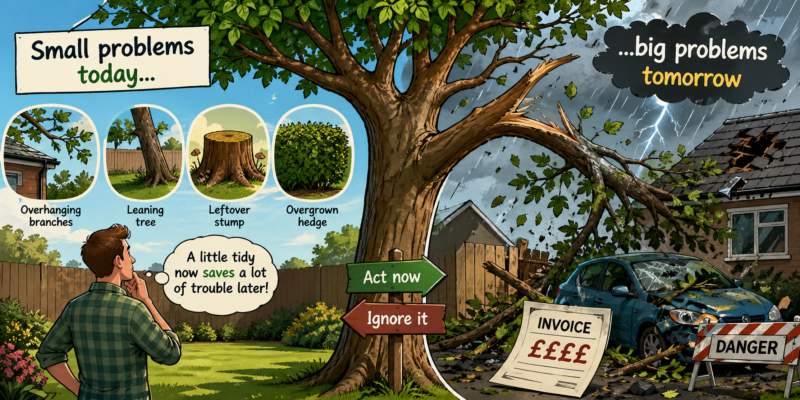 That suspicious little branch over the fence is rarely as innocent as it looks. Today it is gently brushing the neighbour's shed. Next month it may be auditioning for a dramatic entrance through their guttering.
Small tree problems have a habit of growing quietly until they are no longer small, quiet, or polite. A leaning trunk, a cracked limb, an old stump, or a hedge that has swallowed half the path can all seem manageable at first. The trouble is that trees do not send calendar invites before becoming dangerous. They simply keep growing, shifting, weakening, and reacting to weather until something gives way.
Overhanging Branches Are Not Just Untidy
An overhanging branch can look like a minor nuisance. It drops leaves, blocks light, and maybe taps against a window when the wind picks up. Annoying, yes. Urgent, perhaps not. But branches become heavier as they grow, especially after rain, snow, or a burst of new foliage.Once a branch is extending too far from the main structure of the tree, it may place extra strain on the limb joint. That weak point can split without much warning. A branch that seemed harmless in summer can become a proper menace in autumn storms, particularly if it hangs over a roof, driveway, greenhouse, fence, or public path.
Early warning signs include:
- Cracks where a branch joins the trunk
- Dead or leafless branches among healthy growth
- Branches rubbing against buildings, cables, or other trees
- Fungal growth around damaged wood
- Repeated shedding of twigs or bark
Leaning Trees Deserve Attention
Not every leaning tree is dangerous. Some trees grow at an angle naturally and remain stable for decades. The concern starts when the lean appears suddenly, worsens over time, or follows heavy wind, saturated ground, or building work nearby.A tree's stability depends heavily on its roots. If the soil becomes waterlogged, compacted, disturbed, or eroded, the root plate may shift. Once roots begin to lift or tear, the tree can become unstable. This is especially serious near homes, walls, parked cars, sheds, or places where people walk regularly.
A fresh lean should always be treated seriously. Look for raised soil around the base, exposed roots, cracks in the ground, or a visible gap forming on one side of the trunk. These are signs that the tree may be losing its grip. And unlike a wobbly chair, you cannot simply shove a beer mat under it and carry on.
Stumps Do Not Simply Sit There
A leftover stump might look like a harmless reminder of a tree that once stood proudly. In reality, it is more like a slow-moving problem disguised as garden décor. Over time, stumps begin to decay, and that decay can spread into the surrounding soil.As the wood breaks down, it attracts insects, fungi, and moisture. This can create ideal conditions for pests to settle in and then explore nearby healthy plants or even structures. In some cases, new shoots can start growing from the stump, leading to multiple smaller trees appearing where you least expect them. It becomes less of a stump and more of an uninvited sequel.
Removing or grinding a stump early prevents these issues from developing. It also eliminates tripping hazards and frees up space for planting, landscaping, or simply reclaiming a patch of garden that has been quietly plotting against your lawnmower.
Hedges Can Get Out of Hand Quickly
A hedge left to its own devices rarely chooses restraint. What begins as a tidy boundary can become a dense wall that blocks light, restricts pathways, and creeps into neighbouring spaces. Overgrown hedges can also hide structural problems, such as weakened fencing or debris buildup beneath the foliage.Regular trimming keeps growth manageable and prevents the hedge from becoming too woody or top-heavy. Once a hedge reaches a certain size, cutting it back becomes more difficult and sometimes requires more aggressive work, which can affect its long-term health.
Signs that a hedge is slipping out of control include uneven growth, thinning at the base, excessive height, and branches extending into areas where they were never invited. Keeping it in shape is far easier than negotiating with it later.
Simple Preventative Steps Make a Big Difference
Most tree-related issues can be managed early with a bit of observation and timely action. You do not need to become an arborist overnight, but a few practical habits can save a great deal of trouble later.- Inspect trees and hedges after strong winds or heavy rain
- Trim back small problem branches before they grow larger
- Watch for changes in tree position, bark condition, or leaf health
- Remove dead wood as soon as it appears
- Address stumps before they begin to decay extensively
- Keep surrounding soil well-drained and avoid compacting it
Getting to the Root of the Problem
Trees rarely fail overnight without giving some form of warning. The challenge lies in noticing those warnings early and acting before a minor issue grows into something far more disruptive. A branch does not need to crash through a window to prove it was a problem all along.Staying attentive to small changes in your garden keeps you one step ahead. Addressing issues while they are still manageable is not only more cost-effective, it is also far less stressful than dealing with the aftermath of something that could have been prevented. Trees may be patient, but problems within them rarely are.
Article kindly provided by liverpooltreesurgeons.co.uk
Latest Articles
- Can a House Be Too Well Insulated? Understanding the Other Half of Low-Energy Design
- Your Roof Needs to Breathe Too: The Link Between Ventilation, Condensation and Hidden Timber Damage
- Why Your Boiler Behaves Perfectly Until the Weather Turns Cold
- Why Roof Age Is Only Part of the Picture
- How HOA Boards Can Catch Pavement Problems Before They Get Expensive
- Why Vacuuming Alone Eventually Stops Making a Carpet Look Clean
- Designing a Garden That Still Works After the Sun Goes Down
- Why Your Boiler Sounds Different in Summer Than It Does in Winter
- Case Study: Patio Installation Costs in Newcastle
- Why Your Garden Could Be the Most Underrated Fitness Space You Own
- The Hidden Costs of Ignoring Tree Stumps After Felling
- How Much Does a New Roof Cost in Portsmouth? 2026 Pricing Guide
- Choosing the Right Hot Water System for the Way You Actually Live
- Why Beautiful Homes Sometimes Feel Uncomfortable to Live In
- Why Some Homes Always Feel Brighter Without Adding More Windows
- Why Some Roof Leaks Only Appear During Wind-Driven Rain
- Why the Most Memorable Rooms Usually Have One Thing That Feels Unexpected
- Case Study - How Much Does a New Roof Cost in Harrogate?
- Case Study - How Much Does Block Paving Cost in Derby?
- Solar Power: What Happens to Your Energy After Sunset?
- Interior Design
- Home Improvement
- Gardening
- Home Organization
- Home Maintenance
- DIY Crafts
- Kitchen and Dining
- Bathroom Design
- Home Security
- Home Automation
- Green Living
- Home Office
- Home Decor
- Garden Design
- Pet Care
- Home Technology
- Landscaping
- Home Energy Efficiency
- Home Cleaning
- Home Safety
- Home Exterior
- Home Insulation
- Home Buying
- Home Selling
- Renting
- Tradespeople
- Garage
- Bedroom
- Painting and Decorating
- Plumbing and Drainage