

Why Plumbing Problems Behave Differently in Older Tenement Buildings
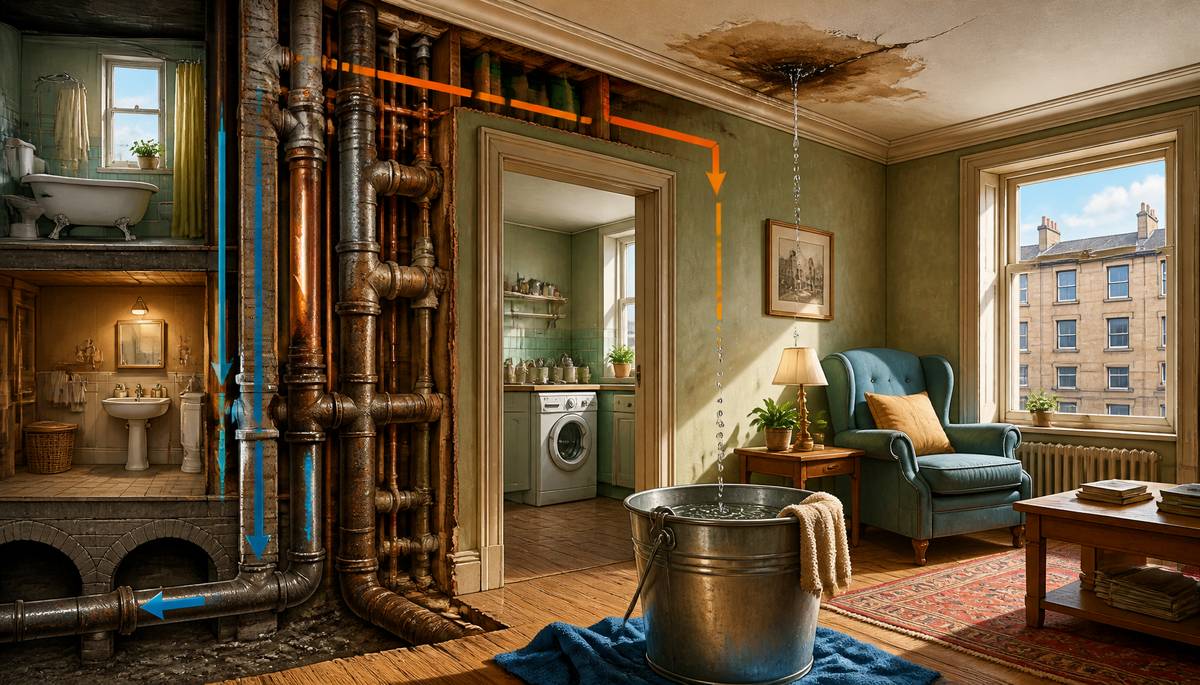 A dripping ceiling in an older tenement flat may have begun its journey surprisingly far from the bucket currently catching it. Water follows gravity, certainly, but it also follows pipes, joists, cracks, old repairs and routes apparently designed by someone who considered architectural drawings an unnecessary constraint. That is why plumbing problems in older tenement buildings can be considerably harder to diagnose than similar faults in modern homes.
Many tenements have been standing for well over a century. During that time, bathrooms have moved, kitchens have been modernised, heating systems have changed and generations of plumbers have added, removed or rerouted pipes. What exists behind today's walls and floors may bear only a passing resemblance to the building's original plumbing arrangement.
One Building Means Plenty of Shared Plumbing
A detached house usually gives you a useful starting assumption: if something goes wrong with the plumbing, the problem probably belongs to that house. Tenement living makes matters considerably more sociable.Several flats may connect to the same vertical drainage stack, with wastewater from kitchens, bathrooms and toilets travelling through common sections of pipework. A blockage affecting one part of that system can therefore produce symptoms elsewhere. Water backing up into a ground-floor property, for example, does not necessarily mean the ground-floor resident caused the obstruction.
This is particularly important when several fixtures begin behaving strangely at once. A single slow-draining basin might indicate a local obstruction. A toilet gurgling while another appliance empties, unpleasant smells appearing from drains, or water rising unexpectedly can suggest that the problem lies deeper within shared pipework.
Old Pipes Have Long Memories
Older buildings can contain an impressive assortment of plumbing materials. Cast iron, lead, copper and more recent plastic pipework may all appear within the same property. Some original pipes may still be performing perfectly well, while others have experienced decades of corrosion, mineral deposits or internal deterioration.Ageing cast-iron drainage pipes can become rough internally, making it easier for debris to accumulate. Joints may also deteriorate gradually rather than failing dramatically. The resulting leak might be tiny enough to remain unnoticed until damp appears somewhere entirely different.
Residents should therefore be cautious about assuming that an apparently minor blockage simply requires enthusiastic plunging or a bottle of aggressive drain cleaner. The condition and material of older pipework matter. A treatment that causes little concern in relatively new plumbing may be inappropriate for an elderly system whose joints have already seen several monarchs and an unreasonable number of bathroom renovations.
Decades of Alterations Complicate the Map
Tenement flats rarely remain unchanged throughout their lives. A kitchen might have been relocated, a bath replaced with a shower, an additional toilet installed or a cupboard converted into a utility area. Each alteration potentially adds another chapter to the plumbing system.The difficulty is that nobody necessarily possesses the complete story. Pipes can disappear beneath floorboards, travel behind boxed-in sections and connect to older plumbing at unexpected points. Previous owners may also have undertaken repairs ranging from excellent professional work to arrangements best described as optimistic.
Before lifting flooring, opening walls or disconnecting fittings, residents should establish what they can about the route of the plumbing and whether neighbouring properties could be affected. Knowing where the internal stop valve is located is particularly important. Knowing whether it actually works is even better.
Water Rarely Respects Flat Numbers
Leaks create another difficulty because the visible damage may not identify the true source. Water can travel horizontally along structural timbers or pipework before finally descending through a ceiling. A stain appearing directly beneath an upstairs bathroom provides a useful clue, but it is not a signed confession.Checking obvious sources such as overflowing appliances, leaking taps and accessible connections is sensible. Beyond that, investigation should become increasingly cautious. Shared services, concealed pipes and unfamiliar alterations mean that dismantling something experimentally can transform one resident's modest leak into several residents' extremely interesting afternoon.
Understanding that interconnectedness is the first step towards investigating an old tenement plumbing problem properly.
Blockages Can Be Further Away Than Expected
When a sink refuses to drain, the natural suspect is whatever recently disappeared down it. Sometimes that suspicion is entirely justified. Grease, food debris, hair and soap residue remain perfectly capable of causing trouble regardless of the building's age. In a tenement, however, the obstruction may be much farther along the system.A blockage within shared drainage can affect several properties or fixtures, particularly when they connect to the same stack. This is why repeatedly attacking one plughole may achieve very little. If neighbouring flats are experiencing similar symptoms, or several drains within one property suddenly become sluggish, the evidence begins pointing away from a simple local obstruction.
Before dismantling traps or reaching for increasingly heroic quantities of drain cleaner, residents should establish the scale of the problem. Asking neighbours whether they have noticed anything unusual may provide more useful information than another hour spent threatening the kitchen sink with a plunger.
Know What You Are Looking At Before Touching It
Some basic investigation is perfectly reasonable. Residents can look beneath sinks for obvious drips, check visible appliance hoses, note when damp patches appear and observe whether problems occur when particular fixtures are used. Photographs can also help document changes in staining, corrosion or moisture.What matters is recognising the boundary between observation and intervention. Older plumbing may include fragile fittings, seized valves and pipework whose apparent stability depends largely upon nobody disturbing it. A corroded connection that has remained watertight for years can begin leaking when twisted or knocked.
Chemical drain cleaners deserve particular caution. Mixing different products is dangerous, while strong chemicals can also complicate subsequent professional work. If somebody eventually has to dismantle the pipe, discovering that it contains a mysterious corrosive soup is unlikely to improve their day.
Residents should also avoid opening communal drainage components without understanding what they serve. Shared plumbing means that somebody else's bathwater, washing-machine discharge or toilet flush may be heading towards the section being investigated. Plumbing has several ways of teaching this lesson, and very few of them are dignified.
Good Information Makes Diagnosis Easier
When professional investigation becomes necessary, useful observations can significantly narrow down the possibilities. Rather than simply reporting "there's a leak", note when it happens. Does the stain worsen after rainfall, after the upstairs shower is used or when the washing machine runs? Does a drain gurgle when another fixture empties? Is the problem constant or intermittent?In shared buildings, establishing whether neighbouring flats have similar symptoms can be particularly valuable. It may help distinguish a fault inside one property from a problem involving communal pipework.
Any known history of previous alterations is useful too. If a bathroom was relocated or a kitchen substantially remodelled, mention it. Old photographs, renovation paperwork and even information from previous owners can sometimes explain why a pipe heads confidently towards somewhere nobody expected it to go.
Going With the Flow
Older tenements have survived because they are robust buildings, but robustness does not mean simplicity. Their plumbing systems have often evolved incrementally, combining original infrastructure with decades of repairs and alterations. What looks like one leaking sink can therefore involve another flat, a shared stack, concealed pipework or a connection installed long before the current occupants arrived.The safest approach is to begin with observation rather than demolition. Identify which fixtures are affected, watch for patterns, speak to neighbours where shared drainage may be involved and locate the relevant isolation valves before attempting anything more adventurous.
Most importantly, remember that water is exceptionally good at making its eventual appearance look like the beginning of the problem. In an old tenement, finding the puddle is sometimes the easy part. Finding out where its journey actually started is where the detective work begins.
Article kindly provided by safeplumbersglasgow.com
Latest Articles
- Why Plumbing Problems Behave Differently in Older Tenement Buildings
- Is Your Bed Frame Making Your Mattress Work Harder?
- Before You Hire a Handyman, Photograph the Problem Properly
- The Repair That Reveals Three More Repairs: How to Handle Scope Creep Calmly
- The 'While You're Here' List: Small Jobs That Are Worth Grouping Together
- The Previous Owner's Strange Decisions and How a Handyman Unpicks Them
- The Guest Test for Small Home Repairs
- How Long Should a Dishwasher Last, and When Is Repair the Better Choice?
- Why Is My Washing Machine Shaking So Much?
- The Weight Test: What Your Wall Can Really Hold
- Why a Door That Still Locks Can Still Be a Security Problem
- The One-Hour Home Audit: Small Defects That Quietly Become Expensive Repairs
- Can a House Be Too Well Insulated? Understanding the Other Half of Low-Energy Design
- Your Roof Needs to Breathe Too: The Link Between Ventilation, Condensation and Hidden Timber Damage
- Why Your Boiler Behaves Perfectly Until the Weather Turns Cold
- Why Roof Age Is Only Part of the Picture
- How HOA Boards Can Catch Pavement Problems Before They Get Expensive
- Why Vacuuming Alone Eventually Stops Making a Carpet Look Clean
- Designing a Garden That Still Works After the Sun Goes Down
- Why Your Boiler Sounds Different in Summer Than It Does in Winter
- Interior Design
- Home Improvement
- Gardening
- Home Organization
- Home Maintenance
- DIY Crafts
- Kitchen and Dining
- Bathroom Design
- Home Security
- Home Automation
- Green Living
- Home Office
- Home Decor
- Garden Design
- Pet Care
- Home Technology
- Landscaping
- Home Energy Efficiency
- Home Cleaning
- Home Safety
- Home Exterior
- Home Insulation
- Home Buying
- Home Selling
- Renting
- Tradespeople
- Garage
- Bedroom
- Painting and Decorating
- Plumbing and Drainage