

Why Your Flooring Looks Different at Night: The Surprising Influence of Artificial Lighting
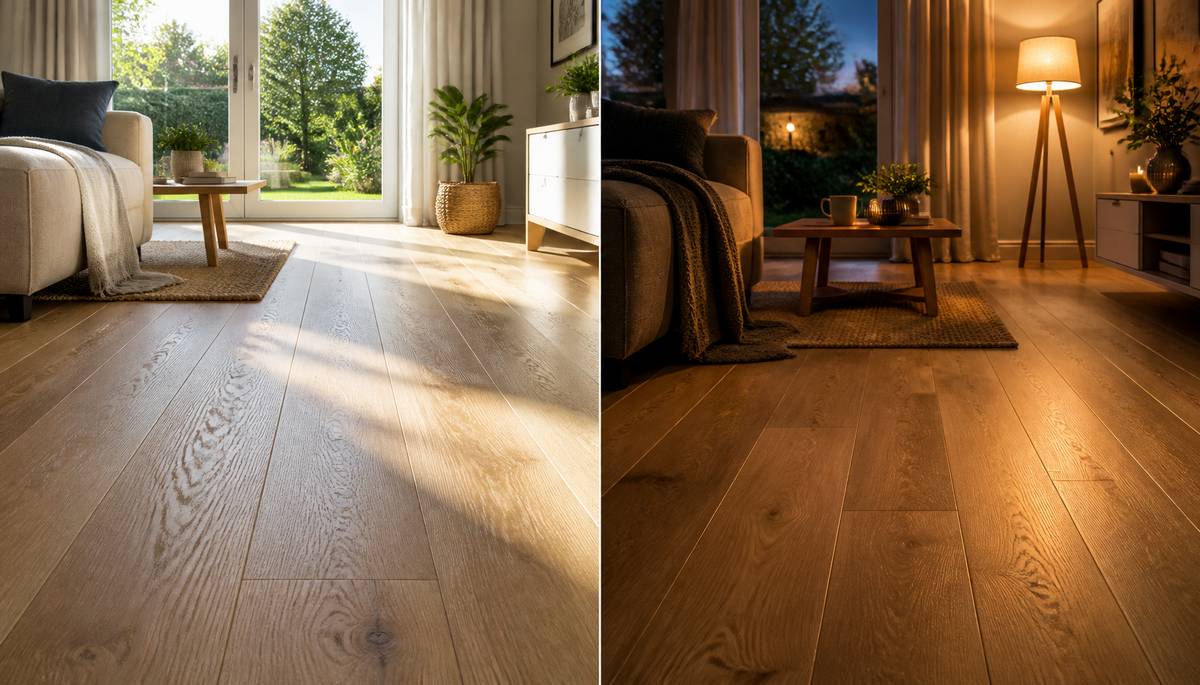 Your beautiful new oak flooring has apparently developed a second personality, and it only comes out after sunset. By day, those carefully chosen planks look sophisticated, natural and reassuringly expensive. Switch on the living room lights, however, and suddenly the floor resembles something rescued from a 1970s caravan. Before accusing the flooring supplier of witchcraft, consider a more likely culprit: your lighting.
The relationship between flooring and light is surprisingly complicated. Colours that appear neutral in daylight can develop yellow, grey or even greenish undertones under artificial illumination. Understanding why this happens can prevent expensive decorating mistakes and help homeowners choose flooring that looks attractive around the clock.
Why Daylight Tells a Different Story
Natural daylight contains a broad spectrum of visible wavelengths, allowing us to perceive colours relatively accurately. However, daylight itself changes throughout the day. Morning sunlight often appears warmer, midday light tends to be cooler, and late afternoon sunshine can introduce golden tones.A pale grey laminate floor might look crisp and contemporary at lunchtime but noticeably warmer during sunset. North-facing rooms generally receive cooler, more diffuse daylight, while south-facing rooms experience stronger direct sunlight.
This explains why a flooring sample that looked perfect in a brightly illuminated showroom can appear completely different at home. The showroom wasn't necessarily misleading you; it simply had different lighting conditions. Your living room, unfortunately, didn't receive the memo.
Warm LEDs and the Mysterious Case of the Yellow Floor
Artificial lighting introduces another variable: colour temperature. Measured in Kelvin (K), this describes whether a light source appears warm, neutral or cool.Warm white bulbs, typically around 2700K to 3000K, produce a yellowish glow associated with cosy living spaces. They can enhance the golden tones of oak flooring but may also make cream-coloured vinyl appear excessively yellow.
Neutral white lighting, around 3500K to 4000K, often provides a more balanced appearance, while cooler lighting above 5000K can emphasise blue and grey undertones.
Neither warm nor cool lighting is inherently better. Problems arise when the chosen lighting exaggerates colours that homeowners were hoping to minimise. A grey floor with subtle blue undertones, for example, may look considerably colder beneath daylight-style LED bulbs.
Why Two Identical Colours Can Suddenly Look Different
One particularly interesting phenomenon is metamerism, where two materials appear to match under one light source but differ under another.Imagine choosing flooring to complement existing kitchen cabinets. Under daylight, the colours appear beautifully coordinated. At night, the cabinets develop a creamy appearance while the flooring takes on a faint pinkish tint. Nobody has secretly redecorated the kitchen; the materials simply reflect different wavelengths of light.
This effect is especially relevant when combining wood-effect flooring with painted furniture, cabinetry or skirting boards. Even materials described using similar colour names may contain different underlying pigments.
The practical lesson is simple: matching colours under one lighting condition isn't enough. A successful combination should be assessed under several types of illumination before any permanent installation begins.
Testing Flooring Samples Without Playing Colour Roulette
The most reliable way to assess flooring is to bring several samples home and observe them in the room where they will eventually be installed. A sample viewed beneath showroom spotlights tells only part of the story, rather like judging a holiday destination entirely from its airport.Place samples directly on the existing floor rather than holding them vertically against a wall. Light strikes horizontal surfaces differently, and the viewing angle can significantly influence the appearance of textured or glossy finishes.
Examine each sample in morning daylight, afternoon sunshine and evening artificial light. If possible, leave them in place for several days. Move them between brighter and darker areas, particularly near windows, beneath ceiling lights and alongside furniture.
Larger samples are especially useful because small pieces rarely reveal how a colour will dominate an entire room. A slightly yellow undertone might seem insignificant on a sample measuring twenty centimetres across, but become considerably more noticeable when covering thirty square metres.
Texture and Finish Can Change Everything
Colour isn't the only characteristic affected by lighting. Surface texture and reflectivity also influence how flooring appears throughout the day.Glossy finishes reflect more direct light, potentially creating bright patches beneath ceiling spotlights or near windows. Matt finishes generally diffuse reflections, producing a more consistent appearance under changing illumination.
Embossed wood-effect flooring introduces another consideration. Directional lighting can emphasise grooves and grain patterns, making the surface appear more textured at night than during the day.
This isn't necessarily undesirable. Carefully positioned lighting can highlight attractive flooring details, particularly in rooms featuring natural wood or realistic luxury vinyl planks. However, strong reflections may become distracting in spaces containing televisions or extensive glazing.
Choosing Colours That Behave Themselves
Homeowners seeking consistency should consider flooring with relatively balanced undertones rather than strongly yellow, blue or pink characteristics.Mid-tone natural oak, muted beige and certain neutral brown finishes can offer versatility across different lighting environments. However, no flooring colour is completely immune to changes in illumination.
The colour rendering index, or CRI, of artificial lighting also matters. Bulbs with a CRI of 90 or above generally reproduce colours more faithfully than lower-rated alternatives, although individual colours can still vary between light sources.
Consistency can also be improved by using bulbs with similar colour temperatures throughout connected living spaces. Mixing warm white ceiling lights with cool white lamps may create an interesting atmosphere, but it can also leave the flooring looking as though different sections were purchased during separate decades.
Putting Your Flooring in the Best Light
Choosing flooring shouldn't involve finding a colour that looks perfect for fifteen minutes on a sunny afternoon. The objective is to select something that remains pleasing under the lighting conditions experienced during everyday life.Before committing to an installation, compare samples against existing furniture, wall colours and artificial lighting. Consider how the room is actually used, particularly during evenings when electric lights become the dominant source of illumination.
Sometimes the simplest solution isn't changing the flooring at all, but replacing unsuitable bulbs or adjusting their positioning. A modest lighting improvement can transform the appearance of an entire room without disturbing a single plank.
After all, flooring is a substantial investment. It deserves to look good after dark, rather than requiring everyone to leave the lights off and admire it by torchlight.
Article kindly provided by flooringmonster.com
Latest Articles
- Why Your Flooring Looks Different at Night: The Surprising Influence of Artificial Lighting
- Resin Bound Driveways in St Albans: Sub-Base, Drainage and Real Costs
- The Strange Things You Can Discover About Your House from Old Maps
- Why Unoccupied Properties Can Deteriorate Faster Than Occupied Ones
- Could That Beautiful Tree Be Quietly Damaging Your House?
- What Scotland's Relentless Rain Can Reveal About Your Home's Plumbing
- Window Privacy: Why Being Invisible During the Day Doesn't Mean You're Invisible at Night
- Why Plumbing Problems Behave Differently in Older Tenement Buildings
- Is Your Bed Frame Making Your Mattress Work Harder?
- Before You Hire a Handyman, Photograph the Problem Properly
- The Repair That Reveals Three More Repairs: How to Handle Scope Creep Calmly
- The 'While You're Here' List: Small Jobs That Are Worth Grouping Together
- The Previous Owner's Strange Decisions and How a Handyman Unpicks Them
- The Guest Test for Small Home Repairs
- How Long Should a Dishwasher Last, and When Is Repair the Better Choice?
- Why Is My Washing Machine Shaking So Much?
- The Weight Test: What Your Wall Can Really Hold
- Why a Door That Still Locks Can Still Be a Security Problem
- The One-Hour Home Audit: Small Defects That Quietly Become Expensive Repairs
- Can a House Be Too Well Insulated? Understanding the Other Half of Low-Energy Design
- Interior Design
- Home Improvement
- Gardening
- Home Organization
- Home Maintenance
- DIY Crafts
- Kitchen and Dining
- Bathroom Design
- Home Security
- Home Automation
- Green Living
- Home Office
- Home Decor
- Garden Design
- Pet Care
- Home Technology
- Landscaping
- Home Energy Efficiency
- Home Cleaning
- Home Safety
- Home Exterior
- Home Insulation
- Home Buying
- Home Selling
- Renting
- Tradespeople
- Garage
- Bedroom
- Painting and Decorating
- Plumbing and Drainage